Ghana
Circular Economy
Execution
We are actively collecting donations to build the first set of washrooms! You can donate directly to this project:
Waste To Infrastructure In Kumasi
Engineers Without Borders Netherlands is partnering with TrashSmart, a Ghanaian waste-management enterprise based in Kumasi, to turn plastic waste into school sanitation infrastructure. The partnership started in 2021 as engineering support. It now covers five pillars: household and school plastic collection, brick manufacture from recycled plastic, waste-management education in schools, a digital platform that formalises the informal collector workforce, and electrification of the collection fleet.

Ghana produces 1.1 million tonnes of plastic waste annually with only 5% currently recycled.
Challenge
Plastic waste pollution remains a serious environmental, social and public-health challenge across West Africa. Ghana produces around 1.1 million tonnes of plastic waste annually, with only a small fraction currently recycled. Many municipalities lack the means to collect and process waste sufficiently. As a result, plastic waste litters streets and countryside and enters waterways and the ocean, harming marine life. Blocked drainage systems become breeding habitats for mosquitoes, which spread malaria, a disease that still claims many lives across sub-Saharan Africa.
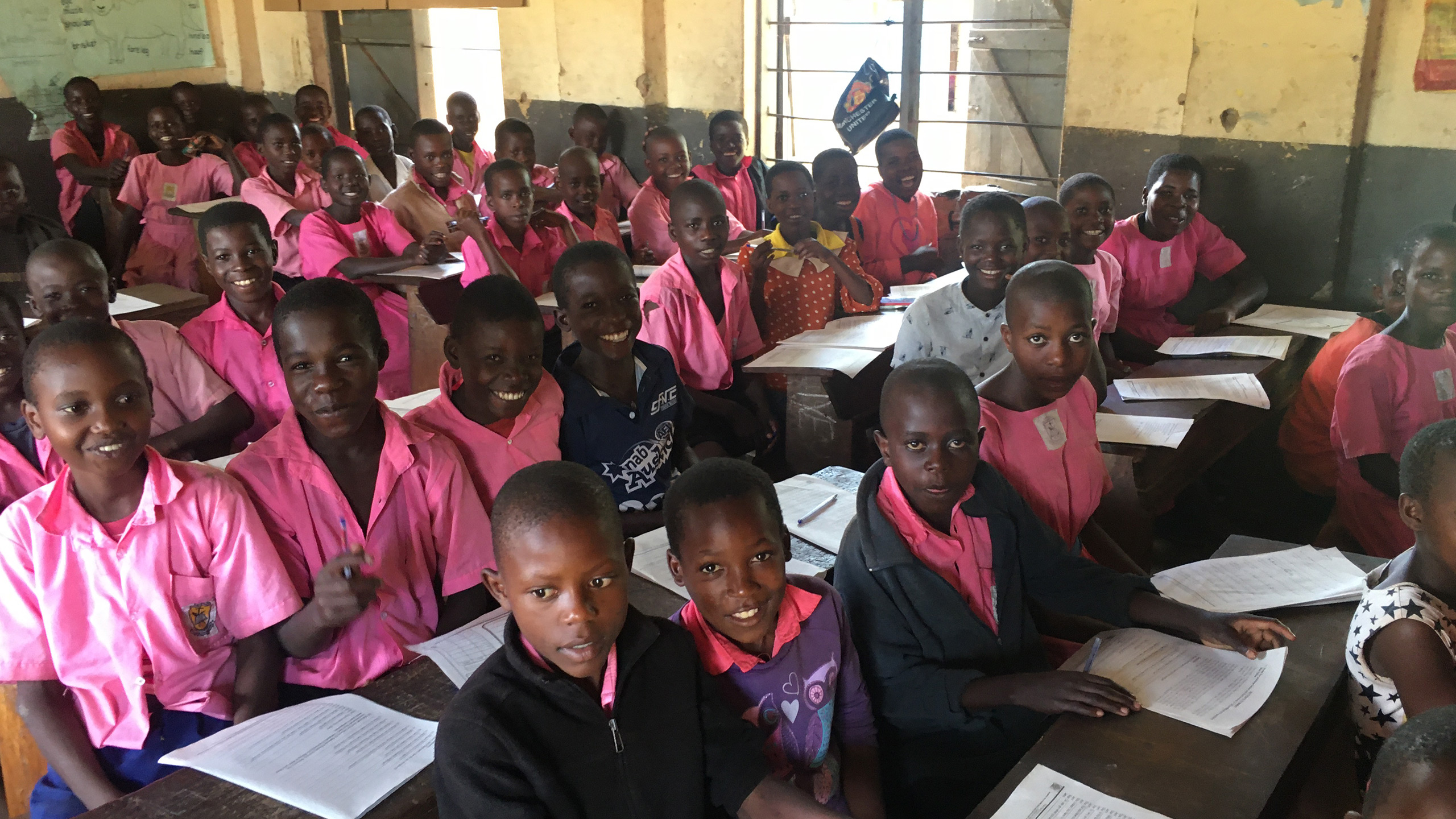
At the same time, many primary schools in the Kumasi region lack adequate sanitation facilities. Where there are no private facilities, girls often stay at home rather than go to school, and female teachers face the same problem during menstruation. This lowers female enrolment and overall school attendance. The Waste to Infrastructure project tackles both problems: it collects plastic waste through formal channels, recycles it into construction bricks, and uses those bricks to build school washrooms.
What the project does
The project has pillars:
1. Plastic waste collection. TrashSmart operates scheduled and on-demand plastic-waste collection for households, businesses, and schools in Kumasi, with progressive formalisation of the informal collector workforce.
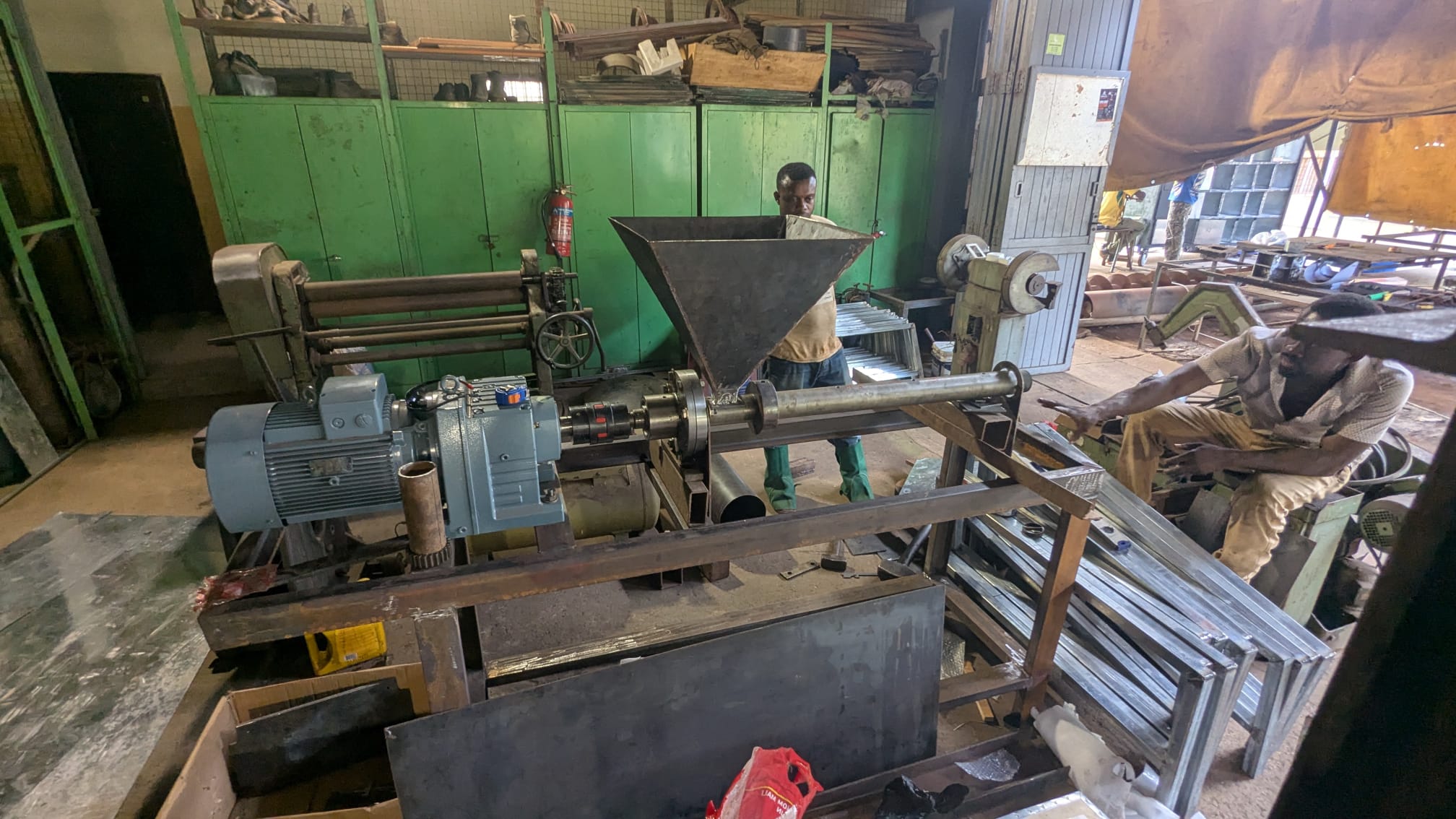
2. Recycling into construction materials. Collected hard plastics are shredded, mixed with sand, and pressed into construction bricks at TrashSmart’s facility. Students from Kwame Nkrumah University of Science & Technology (KNUST) and the University of Twente Humanitarian Engineering Research Group produced the prototype brick.
3. Washroom construction. A pilot washroom is being constructed in Kumasi for a school of approximately 1,000 students. It is the demonstration unit for rolling the design out to other Ghanaian schools. Students from the Delft University of Technology (TU Delft) International Entrepreneurship & Development minor contributed to the washroom design.
4. Schools sensitisation. CGIAR-IWMI’S Resource Recovery and Reuse (RRR) Schools and Youth Programme of which TrashSmart is a major partner, engages students in source-segregation practice across a growing network of partner schools, with over 15,000 students currently participating.
5. Clean-mobility collection. Following a 2025 feasibility study by a Sustainable Energy Technology master’s student at Eindhoven University of Technology (TU/e), in partnership with KNUST, the collection fleet is being electrified through partnerships with Ghanaian e-mobility manufacturers.
Recent milestones
- Pilot school washroom in advanced build (2026, ongoing).
- Container-based mobile production system in fabrication (2026, ongoing). Inspired by TrashSmart’s vision of a mobile production unit, students from Industrial Design Engineering, Mechanical Engineering, and Humanitarian Engineering developed the concept in a hackathon competition, which they won. Using insights and the preferred production layout shared by TrashSmart, they designed the container’s modifications, including the doors and windows. Supervised by the University of Twente Humanitarian Engineering Research Group and co-supervised with EWB-NL, the students continue to fabricate the system, which will be installed in Kumasi in 2026. It can be moved to other locations as TrashSmart expands its business across Ghana.
- Waste to Infrastructure School Washrooms Handbook completed (January 2026). A TU Delft student team, co-supervised by EWB-NL and TrashSmart, wrote a step-by-step construction handbook for two washroom designs based on the interlocking-brick system: a Standard Washroom and a Standard + Extra Washroom that adds changing rooms, a disabled toilet, and dedicated teacher facilities. The handbook covers foundation, brick placement, ventilation, roofing, and interior walls, and includes guidance on bio-digester sewage.
- Electric-tricycle feasibility study completed (Sept–Dec 2025). A TU/e Sustainable Energy Technology master’s-level feasibility study, co-supervised by the university and by an EWB-NL project team member and carried out with KNUST, assessed the costs and benefits, life cycle and local manufacturing options for electrifying the fleet.
- First recycled-plastic brick produced (July 2025). A University of Twente MSc researcher, co-supervised by the university and by an EWB-NL project team member, developed and validated the brick-production process with TrashSmart.
- World Engineering Day Hackathon, 1st Place (4 March 2025). A team of four University of Twente master’s students (ManufacturingBox) won the WFEO/UNESCO global engineering hackathon with their adaptation of the brick-production system, with KNUST and TrashSmart as named local partners.
- Teaching case study published (2024). From Plastic Waste to Infrastructure (Martin, Audu & Mantingh, 2024) was published by the Engineering Professors’ Council under a CC BY-SA 4.0 licence and is now used in several European engineering education programmes: https://epc.ac.uk/toolkit/case-study-from-plastic-waste-to-infrastructure-understanding-circular-business-models-in-context/
Project goals
The project aims to:
- Reduce improper plastic waste disposal in operating catchments by setting up a working plastic-waste-to-construction value chain.
- Build a pipeline of recycled-plastic-brick school washrooms, with measurable impact on girls’ attendance and school sanitation.
- Formalise the informal waste-collection sector through the TrashSmart digital platform, giving collectors predictable income, transparent earnings, and a professional identity.
- Teach school-age children to separate waste at source through the Resource Recovery and Reuse Schools and Youth Programme.
- Electrify TrashSmart’s collection fleet in partnership with Ghanaian e-mobility manufacturers, reducing fleet emissions and creating local skilled employment.
- Train local people throughout the value chain (production technicians, collectors using the app, e-mobility maintenance staff and sensitisation facilitators) so that the project stays locally owned.
Sustainable Development Goals
The project contributes directly to six Sustainable Development Goals and supports six more.
Primary Contribution — headline goals we directly deliver on
SDG 3 — Good Health and Well-being. Reduces malaria vectors from blocked drains; improves school hygiene. Schools without water, sanitation and hygiene (WASH) facilities also see more diarrhoeal disease and absenteeism.
SDG 4 — Quality Education. Better sanitation raises school attendance and enrolment. This is one of the best-measured links between WASH facilities and education.
SDG 5 — Gender Equality. Washroom facilities close the gender attendance gap. Female students and teachers are disproportionately affected by inadequate WASH facilities. Closing that gap is one of the project’s main outcomes.
SDG 6 — Clean Water and Sanitation. New WASH facilities where none existed; less drainage contamination through reduced plastic disposal into open drains and waterways.
SDG 11 — Sustainable Cities and Communities. Circular urban waste management in growing Ghanaian cities. The container-based production system is how the project will expand to new locations.
SDG 12 — Responsible Consumption and Production. Turns plastic waste into useful infrastructure.
Supporting Contribution — reinforced through the integrated value chain
SDG 7 — Affordable and Clean Energy. Fleet electrification reduces fossil-fuel dependence.
SDG 8 — Decent Work and Economic Growth. The TrashSmart platform formalises the informal collector workforce, giving collectors predictable income, transparent earnings, ratings-based reputation, and access to financial services.
SDG 9 — Industry, Innovation and Infrastructure. Infrastructure fabricated and built locally, by local artisans.
SDG 13 — Climate Action. Cement displacement; fleet electrification; reduced open-burning of plastic waste.
SDG 14 — Life Below Water. Less plastic reaching waterways and, ultimately, the ocean.
SDG 17 — Partnerships for the Goals. Cross-sector collaboration: TrashSmart as the local enterprise, students and EWB (student chapter) from KNUST on the Ghanaian side, students from University of Twente, TU/e, and TU Delft as international university partners, and EWB-NL as project lead and co-supervisor.
Partners
Local partner
- TrashSmart — Kumasi, Ghana. Local lead enterprise. Founder & CEO: Afua Asarebea Opare-Baidu. Website: trashsmart.org
Local university and fabrication partners
- KNUST — Kwame Nkrumah University of Science and Technology, Kumasi. Research and student-exchange partnership.
International university partners
- University of Twente, Humanitarian Engineering Research Group (Industrial Design Engineering, Mechanical Engineering, and Humanitarian Engineering) — brick design and structural testing.
- TU Delft Students on Hand Book.
- TU Eindhoven on electrification on fleet.
Project lead
- Engineers Without Borders Netherlands (EWB-NL) — engineering technical leadership, project coordination, and partnership development.
Needs
The project is looking for financial and strategic partners to support:
- Pilot washroom completion and replication to additional Ghanaian schools
- Scale-up of brick production capacity at the TrashSmart facility
- TrashSmart app development and rollout, including mobile-money payment integration and B2B contract features
- Deployment of the first electric collection tricycles in partnership with Ghanaian e-mobility manufacturers
- Continuation of the RRR Schools and Youth Programme
Get in touch through the EWB-NL Become-a-Partner page, or contact the project lead directly through EWB-NL.
Donate to the project via the QR code or link below: